
Schools
A school year on the Costa del Sol: choosing a school and shaping family life
29 September 2026 · 6 min read
Reviewed by Thomas Kjærrgård
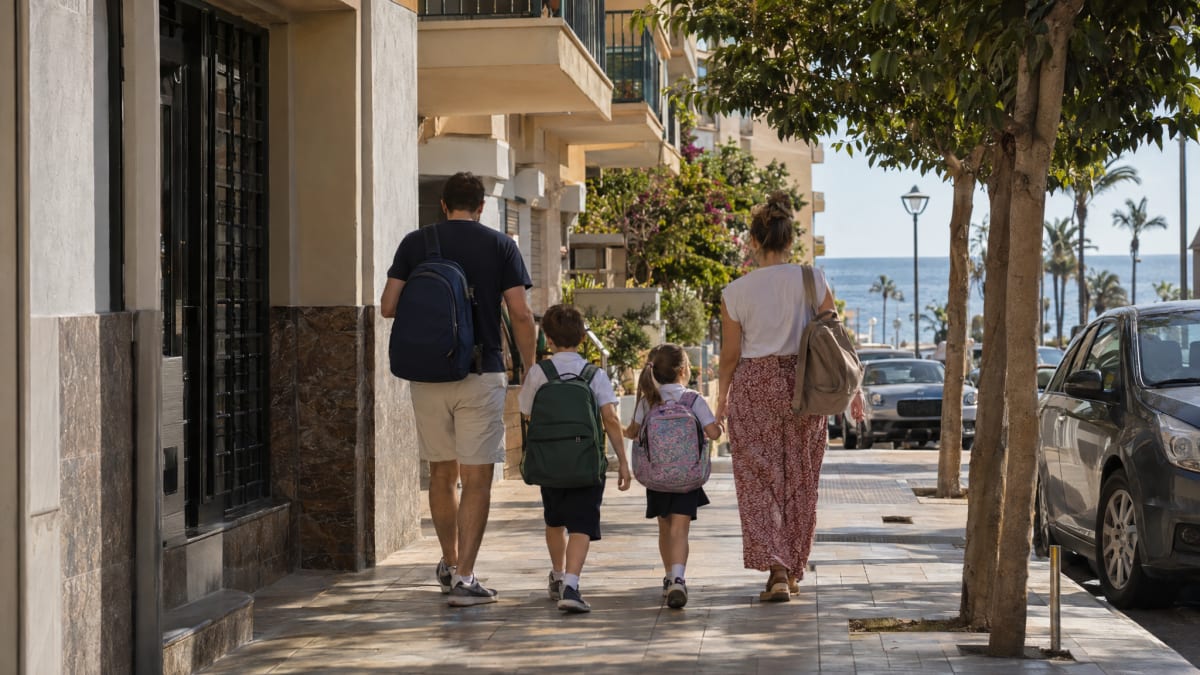
Choose the school before you choose the home. For a year or longer on the Costa del Sol, your child's classroom language, year group and journey to school will help shape where you live and how your weekdays work. You can follow the Spanish system, continue with a Nordic curriculum or consider an international programme. The useful question is not simply which school you like, but how its teaching, admissions and afternoon arrangements fit your family.
How Spanish schooling works, and how you apply
Your first decision is which stage your child will enter. Infantil is voluntary, with a first cycle for children under three and a free second cycle from three to six. Compulsory, free basic education normally runs from six to sixteen: six years of Primaria, usually from six to twelve, followed by four years of Educación Secundaria Obligatoria, or ESO, usually from twelve to sixteen. Bachillerato normally takes a further two academic years. The next choice is the school model. Public schools are publicly owned. Concertados, often called semi-private schools, are privately owned but operate under public educational funding agreements. Private schools form the third option. Public and concertado schools cannot charge for teaching that is legally free or require compulsory donations; extracurricular activities and school services are voluntary. This distinction matters when you compare the teaching itself with the services surrounding the school day. For public and concertado places in Andalucía, admission and enrolment are separate steps. You submit an admission application through the Junta de Andalucía, electronically or in person, then complete the enrolment form for the relevant stage. Where applications exceed places, criteria include siblings already attending, proximity to home or a parent's workplace, household income and disability. There is also an extraordinary admission procedure for applications outside the ordinary process. Check the calendar for your intended school year before making plans. The procedure's general explanatory text gives an ordinary application period of 1 to 31 March, while its dated table for 2026/27 listed 1 March to 7 April 2026. For that same cycle, enrolment ran from 1 to 8 June for second-cycle Infantil, Primaria and special education, and from 1 to 10 July for ESO and Bachillerato.

Nordic schooling from Benalmádena to Marbella
At Den Norske Skolen, Málaga, the daily journey may be on foot with a parent, by car or, for some older pupils, by train or bus. The school is in Arroyo de la Miel, Benalmádena, at Avenida Cerro del Viento, s/n, and teaches Years 1 to 10 using the Norwegian curriculum and Norwegian authorities' requirements. Applications use a digital form and require documentation of Norwegian citizenship and a passport copy. A waiting list is created when applications exceed places. The school has no school bus, school-age childcare arrangement or other after-school activities, so your afternoon arrangements belong in the housing decision too. For Swedish schooling, Fuengirola and Marbella offer different paths. Svenska skolan i Fuengirola provides regular teaching in förskoleklass, Years 1 to 9 and gymnasium. Svenska skolan Marbella provides regular teaching in Years 1 to 6, with supervised distance education for pupils in Years 7 to 9 and gymnasium. Swedish overseas schools teach in Swedish and follow Swedish curricula as far as possible. The distinction between classroom teaching and supervised distance study is particularly relevant if you are moving with a teenager. In Los Pacos, Fuengirola, Aurinkorannikon suomalainen koulu, also known as Colegio Finlandés, offers pre-primary education, Finnish basic-education Years 1 to 9 and upper-secondary lukio. It is a private school operating under Finland's basic and upper-secondary education legislation, with authority to issue certificates. Its curricula are based on Finland's national curricula. School healthcare, a school social worker, a psychologist, special education and classroom support staff form part of its pupil-welfare provision, and meals are prepared on site. For Danish-language provision, AIM School in Mijas offers Danish teaching through Grade 8 with Danish teachers, within a school where the main teaching language is English. Its age range runs from Mini AIM for ages three to six to AIM School for ages six to fourteen, from børnehaveklasse through Grade 8. It is a different educational route from the Norwegian, Swedish and Finnish curriculum options.
International schooling: look closely at language and curriculum
At AIM School, the school day combines English as the main teaching language with an international curriculum and Danish-language teaching. Its address is Diseminado Rincón del Hinojal, 20, Mijas, and its setting includes an olive grove. As a subscribed school of the International Curriculum Association, it delivers the International Primary Curriculum, IPC, and International Middle Years Curriculum, IMYC, within its provision for ages three to fourteen. This gives you a concrete international option to consider alongside the Nordic schools. The important comparison is the programme your child will actually follow: an English-main-language international curriculum with Danish teaching is a different choice from continuing Norwegian, Swedish or Finnish schooling. Ask for the curriculum, language support and current fees for your child's exact year group in one enquiry. If you expect to return to Sweden, plan the return with the destination municipality early; the right to education does not secure the same school or class your child left.
After school: activities, childcare and children's health
Afternoons need their own plan, especially where school does not provide childcare or activities. In Fuengirola, municipal provision for 2026/27 includes sports schools, instructor-led land-based activities and pool activities, as well as the Escuela Municipal de Fútbol de Santa Fe de Los Boliches. These give you practical options to place alongside the school day when comparing neighbourhoods and journeys. Municipal activities have their own registration timetable. In Fuengirola's 2026/27 programme, existing participants renewed first, and registration for new users opened on 5 August 2026 for the places remaining. General renewals were available through the municipal sports website, the Deportes section of the Tarjeta Ciudadana app or the sports offices at Complejo Deportivo Elola. The football school required renewal in person. For your intended year, check the municipal programme's registration dates alongside the school calendar. Children's public healthcare in Andalucía includes a preventive programme of 12 scheduled visits from birth to age fourteen. Follow-up takes place through primary and community healthcare, particularly with paediatricians and child-and-adolescent nursing professionals. Visits cover development and health, screening, prevention and advice on healthy living, including physical activity, sun protection, emotional wellbeing and screen use. The Una ventana abierta a la familia platform also provides information for parents and carers. Before settling on a home, bring the parts of an ordinary weekday together: the journey to school, who is available at collection time, and where an afternoon activity would fit. Start by narrowing your school options to the right year group and teaching language, then use that shortlist to choose the area where your family can build its daily routine.


Stay informed on the Costa del Sol
Subscribe to get the latest posts sent to your email
By subscribing, you agree to receive Solkysten’s newsletter by email. You can unsubscribe at any time using the link in each email. How we use your information