
Lifestyle
Beaches and promenades on the Costa del Sol: a seafront for everyday life
18 August 2026 · 7 min read
Reviewed by Thomas Kjærrgård

When you own a home near the sea, the useful question is not simply which beach looks best. It is where you can take a regular walk, combine a swim with a trip into town, or find somewhere to eat outside summer. Along the Costa del Sol, those routines take different forms: a landscaped boulevard in Estepona, long urban promenades in the central towns, or the beaches and rocky coves towards Nerja. The beach itself matters, but so does the stretch of coast you will actually use in February or October.
The west: town beaches, sheltered coves and dunes
In Estepona, you can combine time by the water with errands in the centre. Playa de la Rada sits close to the principal streets, with a spacious promenade running beside it towards the fishing port. At almost three kilometres, that promenade gives you a substantial everyday walk without leaving the town. The pedestrianised seafront boulevard adds planted areas and flowers between the buildings and the sea, and connects with the Senda Litoral coastal path. Estepona has more than 23 kilometres of low, sandy coast and 17 beaches, so living by La Rada offers a different routine from choosing a home near one of the coves. Playa del Cristo has a sheltered setting and a wooded section, making it a useful option for time at the beach with children. Further west in Manilva, La Duquesa and El Castillo form a stretch about 1,600 metres long, with moderate waves. Here, the beach itself can provide the distance for a walk along the water. Marbella brings another contrast. Its coastline extends for more than 27 kilometres, while Artola and Cabopino offer dunes and white sand. That is a different setting from Estepona’s central boulevard: the attraction is the beach landscape rather than the ease of combining the shore with the main shopping streets. For your own daily routine, the choice is between having town and beach closely together and making the coast itself the destination.
The central coast: promenades as a daily route
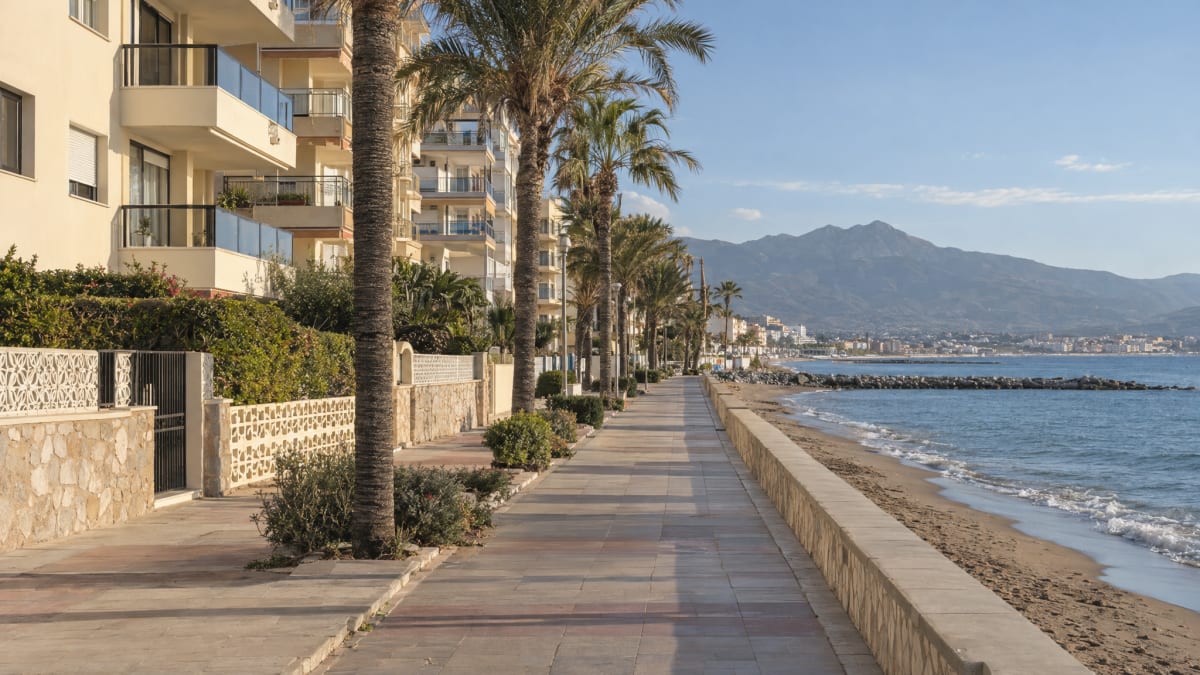
In Fuengirola, Benalmádena and Torremolinos, the promenade is a practical starting point for choosing where you want to live. Fuengirola has a long seafront walk, with Playa del Castillo below Castillo Sohail adding a cultural dimension through summer concerts and performances. Benalmádena Costa also has an extensive promenade and a marina. At Bil Bil, fine dark sand, the adjoining castle and a beach about 400 metres long give you a more compact stretch to return to regularly. Mijas Costa offers a different beach texture. Butibamba has medium grained dark sand, moderate waves and rocky areas used for snorkelling. At 1,300 metres long, it gives you room for a beach walk as well as a swim. The rocky coast between Calahonda and Calaburras is also one of the natural areas included in the Senda Litoral project, bringing a different setting to a coastal walk from the urban promenades. In Torremolinos, the seafront takes you past areas including La Carihuela, El Bajondillo, Playamar and Los Álamos. Walking and eating at a chiringuito, the Spanish beach bar, are part of the appeal here. Los Álamos has dark sand and moderate waves, with watersports among its activities. If you want the sea to be part of an ordinary afternoon rather than a separate excursion, these central towns put walking, beach time and places to eat into the same coastal setting.
The east: city beaches, long walks and the coves of Maro
In Málaga, a beach visit can sit within a city day. Malagueta lies between the port and La Caleta, with 1,200 metres of beach. Further east, Pedregalejo and El Palo are other city beach options. Beyond Málaga, Rincón de la Victoria has nine kilometres of fine sand beaches and a maritime identity, giving you another way to keep the shore central to daily life without choosing one of the western resorts. Torre del Mar is worth considering if the walk matters as much as the swim. Its promenade runs for more than four kilometres, giving you a clear route for a longer outing. Nearby Caleta de Vélez has beaches around its port. Further along, Torrox has nine kilometres of beaches, including El Peñoncillo, Ferrara and El Morche. Ferrara combines dark sand and moderate waves with an adjoining promenade, a useful pairing when you want to move easily between walking and sitting by the water. Nerja’s nine kilometres of beaches include Burriana, where more than 800 metres of fine dark sand sit beside a promenade with restaurants and shops. The cliffs at Maro contain undeveloped coves, offering a very different coastal experience. For a home search, that distinction is useful: Burriana brings the beach and everyday facilities together, while Maro’s appeal lies in its cliffs and coves.
The beach year: lifeguards, winter lunches and the Senda Litoral
Your seafront walk can remain part of life beyond summer, but supervised swimming follows local calendars. Marbella’s announced 2026 lifeguard service covered all of Semana Santa, then weekends and public holidays until 1 June, with daily service from 1 June to 30 September. Its stated hours were 12:00 to 19:00 in low season and 11:00 to 20:00 in high season. Málaga’s high season lifeguarding runs daily on all beaches from 15 June to 15 September, from 10:00 to 20:00. Its medium season service runs from 11:00 to 19:00 throughout Semana Santa, on subsequent weekends until 15 June, and on weekends from 15 to 30 September, at selected beaches including Malagueta, Caleta, Pedregalejo and El Palo. Before an out of season swim, check the current lifeguard timetable for your particular beach. Beach bar opening patterns also shape the year. In Mijas in October 2026, some establishments were staying open until the end of November, while others were considering continuing through winter. Patterns varied between stretches of coast. For you as an owner, that makes an autumn lunch by the sea a realistic part of life in some areas, with the seasonal rhythm depending on the individual establishment. The latest official Blue Flag beach list covers 2026 and 2027, under a temporary two year award arrangement subject to continued compliance and annual monitoring. Awarded beaches include Sabinillas in Manilva, El Faro and Cabopino in Marbella, El Bombo in Mijas, Carvajal in Fuengirola and Benalmádena, Los Álamos in Torremolinos, and Malagueta in Málaga. Further east, Torre del Mar, Ferrara in Torrox, and Burriana and Maro in Nerja also appear. It is a useful reference alongside the qualities you will notice most often: the sand, the walking route and the relationship between the beach and the town. The Senda Litoral gives those local routines a wider coastal framework. The project extends over 180 kilometres through 14 municipalities, linking coastal places and recovering public space beside the sea. Its natural settings include Punta Chullera in Manilva, the Dunas de Artola, the Guadalhorce estuary and the Vélez river delta. Organised environmental walks in September and October 2026 also showed how these routes are used beyond the main bathing season. For your next visit, choose two towns with different seafront settings and walk the stretches you would use on an ordinary day.


Stay informed on the Costa del Sol
Subscribe to get the latest posts sent to your email
By subscribing, you agree to receive Solkysten’s newsletter by email. You can unsubscribe at any time using the link in each email. How we use your information